
What should I do when temptations seem overwhelming?
The Church asks us to focus on the two aspects of holiness: fully living the new life in Christ that began with our baptism, and resisting temptations that hinder us from experiencing that new life.
St. Paul describes the new life that we have in Christ and makes it clear what we must do to maintain that life within us: "Put to death therefore what is earthly in you: fornication, impurity, passion, evil desire, and covetousness, which is idolatry."
However, no matter how long we have been striving to follow Christ and not our own will, it can be challenging. Just when we think we have overcome one temptation, another one emerges.
The fact that we are not yet perfect, at least not as perfect as we believe we should be, can be frustrating. Moreover, it reveals that the sin of pride is still present.
So, what should we do? We must respond to God in all circumstances, even when we feel spiritually defeated.
Although we may feel like a lost cause, Scupoli advises, "You must consider yourself victorious as long as it does not seem that you have openly surrendered. It may seem as though we are defeated, but as long as we still know what is right and have a desire to do right, we should not lose heart and should begin again."
In such situations, we should strike a blow against the enemy and the passion, saying, 'Help me, Lord, save me, my God; Jesus, Mary, help me avoid surrendering to them.'" Often, this brief prayer will bring about deliverance from Christ swiftly. But what if it does not work immediately?
If you are calm enough to reflect on the matter with God, you should consider five points. First, you may have brought this temptation and its suffering upon yourself due to past sins. If so, "justice demands that you patiently endure the wound."
Second, you may not have brought this specific temptation upon yourself. However, perhaps it is a punishment that God has given you for something else. Remember, God's punishments are disciplinary measures intended to shape those whom He loves.
Third, if you believe your conscience is clear, recall that no one enters the kingdom of heaven except through the narrow door of struggle.
Fourth, remind yourself that the Son of God, along with all His saints and friends, entered glory by enduring thorns and crosses.
Fifth, always remember that when you are most tempted, God's love for you remains unwavering, and He "is indescribably pleased by every act of virtue and mortification that He sees you doing." The more difficult things are, the more you will bring pleasure to the Lord."
Temptation and the suffering it causes may appear overwhelming and even purposeless. However, they are neither. "I can do all things in him who strengthens me," St. Paul assures us. We may be weak, but God's power "is made perfect in weakness."
Torreciudad: Jesus’ Proclamation of the Kingdom of God. Fruit of the 3rd Luminous Mystery: Call to bring people closer to Jesus.Video:

The saints' unbreakable union with Jesus is exemplified by the remarkable account of martyrdom in the early Church involving two African mothers, Saints Perpetua and Felicity.
Perpetua and Felicity, who lived during the third century (c. 182[5] – c. 203), were Christian martyrs. Perpetua, a noblewoman who had recently been married, was well-educated and believed to be 22 years old at the time of her death. She was also a mother who was nursing her infant son. Felicity, a slave woman who was pregnant at the time, was imprisoned alongside Perpetua and was martyred with her. They, along with others, were put to death in Carthage, which was located in the Roman province of Africa.
Perpetua was accused of being a Christian and was confined in a dungeon with other Christians. Her father frequently visited her in jail, pleading with her to renounce her faith so that she could be released. He expressed how much he valued her above her siblings and how she was the light of his life. Despite her father's pleas, Perpetua was unwilling to renounce her Christian faith. She mourned the fact that her father and other family members could not share in her joy as she prepared to face martyrdom.
Felicity, too, refused to renounce her faith and was imprisoned in the same place as Perpetua. Since pregnant women were not allowed to be publicly tortured, Felicity -strong in her Faith- fervently prayed for the early birth of her child so that she could be martyred alongside the others. The other prisoners joined her in passionate prayers to God, asking for the safe delivery of her baby. Miraculously, their prayers were answered, and Felicity's sister took the child and raised her as her own daughter.
The soldier who guarded them was astonished by the holiness demonstrated by the Christian prisoners, including the two young mothers. He allowed many visitors to come and encourage them. On the day of their martyrdom, Perpetua, Felicity, and their companions entered the amphitheater with joyful expressions. Perpetua walked with the confidence of a bride of Christ, assured of God's love for her. Felicity rejoiced, considering the blood she was about to shed as a second cleansing, akin to the purification after childbirth and a second baptism. When Felicity was knocked down by a wild cow, Perpetua, in a very feminine manner, extended her hand and helped her pull down her skirt. Ultimately, both women were killed by wild beasts and the swords of their executioners. Perpetua even noticed fear in the eyes of her executioner, so she guided his sword to her neck, and the two young women received their eternal reward.
This account of the martyrdom of Perpetua and Felicity portrays the women willingly embracing their death, following the example of Christ, who willingly sacrificed himself on the cross for us. Just as Christ's death had purpose and efficacy, the early Church martyrs saw their own deaths as meritorious and considered it a privilege to walk in the footsteps of Christ.
Torreciudad: The Wedding at Cana. Fruit of the 2nd Luminous Mystery: To Jesus through Mary.Video:

Bringing the light of Christian doctrine to a confused world; St. Josemaría always urged us to carry out this task: "Do you see how science, art, agriculture and industry are being de-Christianized, along with the people who work in them? Do you see how the number of large families is decreasing? Don't you suffer when you encounter the sort of 'naturalistic' outlook which is incapable of understanding self-denial, hidden dedication or the evangelical virtues?"
Our Lord came to give life to all, and expects us to participate in his mission. We must go forth and bring sound doctrine to everyone because we are concerned about all souls. However, we must start with those whom God has placed by our side.
We must eliminate ignorance by sharing an abundance of revealed doctrine, the truth of Christ. The Christian apostolate, even for an ordinary Christian living among equals, involves the great work of teaching. Through genuine, personal, loyal friendship, we can instill a hunger for God in others, and help them discover new horizons. This should be done naturally and simply, by fully living our faith and speaking loving words filled with the power of divine truth.
We have been taught that regardless of the external forms our apostolates may take, they always aim to provide doctrine. We must teach doctrine at every opportunity, and create opportunities where none exist. We must passionately teach the truth of Christ and allow others to partake in the treasure we have received.
We should never fear the development of human knowledge because all intellectual efforts, if serious, are aimed at truth. Christ himself said, "I am the truth."
Christians should have a hunger for knowledge. Everything, from abstract knowledge to practical skills, can and should lead us to God. There is no human endeavor that cannot be sanctified, and serve as an opportunity for our own sanctification, and cooperation with God in the sanctification of the people we work with. The followers of Jesus Christ should not hide their light in a valley but place it on a mountain peak so that others may see their good works and give glory to their heavenly Father.
In addition to doctrinal formation, we also need the gift of tongues. However, this gift does not necessarily mean knowing multiple languages but rather knowing how to adapt to the capacities of our listeners.
It is not about simplifying the message for the masses, but about speaking words of wisdom in clear Christian language that everyone can understand.
Torreciudad: The Baptism of Jesus in the Jordan. Fruit of the 1st Luminous Mystery: Openness to the Holy Spirit, making use of his grace.Video:

We have been created for Heaven. Our Lord promised his disciples that he would be with them forever. He said, "I will come again and take you to myself, so that where I am, you may be also."
The Apostles, who were saddened by Peter's predicted denials, found comfort in the hope of Heaven. The return that Our Lord is referring to includes his second coming at the end of the world, as well as the meeting with each soul when it leaves the body. Our death will be a meeting with Christ, whom we have tried to serve throughout our lifetime. He will bring us to the fullness of glory and our meeting with his Heavenly Father, who is also our Father. In Heaven, where a place has been prepared for us, Jesus awaits us. It is the same Jesus who is with us, who awaits us in prayer, and with whom we have often had intimate conversations.
"Our regular conversations with Our Lord give birth to the desire to be with him. Faith sweetens much of the bitterness of death. Our love for Jesus completely changes the meaning of that final moment that comes for everyone. Those in love try to see each other. People in love have eyes only for their beloved. That's logical, isn't it? The human heart feels this need. I would be lying if I denied my eagerness to contemplate the face of Jesus Christ. 'I will seek your countenance, O Lord'." (J. Escrivá)
"The thought of Heaven helps us detach from the things of this world and overcome difficult situations. We bring joy to God when we foster the theological virtue of hope, which is united with faith and love. There will be times when we will need it greatly. When tempted, think about the love waiting for you in Heaven. Foster the virtue of hope — this is not a lack of generosity." The same applies during moments of great sorrow and trial, and when it's very challenging to remain faithful or persevering in our work or apostolate. The reward is significant, and it's just around the corner, not far away.
Meditating on Heaven, our destination, should encourage us to be more generous in our daily struggle, because the hope of the reward comforts the soul and leads to good works.
Words are inadequate to describe our life in Heaven, the life that God has promised to his children. The Church reminds us that we will be with Christ and "we shall see God." It is in these promises and marvelous mysteries that our hope essentially lies. Our imagination may not be able to comprehend these heights, but our heart does so instinctively and completely.
Excerpts from In Conversation with God by F. Carvajal.
Torreciudad: The Finding of Jesus in the Temple. Fruit of the 5th Joyous Mystery: Seek God’s Wisdom and True Conversion, the Joy of Finding Jesus.Video:

Penguins and the Puzzle Palace.
Life, by God's design, is a puzzle palace for us. Were Adam and Eve's parents monkeys? Did we all evolve together? Are there tribes that are part human and part ape? Do we have superior human races and genetically inferior tribes? The truth, wrapped in God's poetry, is more compelling than these theories wrapped in hypothetical scientific narratives. God creates. We don't know when or how. We are all one human race, with Jesus as our Divine King, who "did not come to be served but to serve, and to give his life as a ransom for many" (Mt. 20:28).
The puzzles of nature help us understand God's mind. A living penguin may be more fascinating than its evolutionary story. The acclaimed 2005 nature documentary, "March of the Penguins," depicts the annual journey of penguins in Antarctica. In autumn, all breeding-age penguins leave the ocean and travel inland to their ancestral breeding grounds. There, they engage in courtship rituals that, if successful, result in the hatching of chicks. To ensure the survival of their offspring, penguin parents must make numerous treacherous trips between the ocean and the breeding grounds in search of food.
Penguins are monogamous. The female lays a single egg, and both parents must cooperate for the chick to survive. The male tends to the egg in extreme cold, while the female returns to the sea to gather extra food. As temperatures drop to -80 °F, the males huddle together and incubate the eggs. When the chicks hatch, the males feed them a small meal. There is a scene in the documentary where almost-starving chicks extract sustenance from the throat sacs of their fathers. The mothers return to feed and bond with their young. In spring, as the ice melts and the distance to the sea decreases, the penguins make their return journey, leaving their chicks behind to fend for themselves.
The penguin's story imparts many practical life lessons. They are monogamous, with distinct and complementary roles for both parents in providing for and protecting their young. Penguins risk their lives to care for their offspring. The entire drama is a lesson in both triumph and tragedy. Our own lives resemble this in many ways. These amusing creatures help us unravel the mystery of our existence.
The puzzles of nature inspire us to appreciate and rejoice in the glorious reality of God's creation. The puzzles of our faith inspire us to enrich our lives with the vision of our eternal salvation.
Excerpts from Fr. Jerry Pokorsky
Torreciudad: The Presentation of Jesus at the Temple. Fruit of the 4th Joyous Mystery: Obedience to God’s Will.Video:
The need for prayer of petition. The Church invites us to be filled with confidence. “Because we have died with Christ, we believe that we shall also come to life with him."
However, the time has come to think about Jesus' final recommendation to his disciples when he left them. “Truly, truly, I say to you, if you ask anything of the Father, he will give it to you in my name. Hitherto you have asked nothing in my name; ask, and you will receive, that your joy may be full."
We need to pray, lifting our hearts up to God. He is watching us from heaven. We should ask him for everything we need. The Lord is infinite wisdom; he knows exactly what we need in order to become saints and apostles. “Your heavenly Father knows that you need these things." And yet God wants to be begged. He wants to be coerced. He wants to be won over by a certain persistent begging ... Be persistent therefore, in prayer. Be timely in petition, and never cease asking.
Our Lord knows perfectly well what our needs are, yet he wants us to ask with the same persistence as the people in the Gospel: Lord, if you will, you can make me clean! Lord, that I may see! Ask the same way they did: they asked him for everything. I won't say that man's life should be spent in nothing but asking, for there are times when one sees the need to abandon oneself and one ceases to ask, but later on, one comes back to it.
There should be constancy in prayer of petition. Ask and it shall be given to you; seek and you shall find; knock and it shall be opened to you. For everyone who asks receives; and he who seeks, finds; and to him who knocks, it shall be opened. The only method is perseverance. Ask, ask, ask.
“If we each personally persevere in prayer, our Lord God will give us all the means we need in order to be effective in spreading his kingdom on earth.
Do you see how God favors those who persevere?
Knock, knock and it will be opened to you!"
St John Chrysostom writes: “If somebody tells me that he has requested once, twice, three times, ten times, twenty times, and still has not received anything, I will answer: do not stop, my brother, until you have received it. Petition ends with the reception of the gift. Stop when you have received it. Rather, do not stop even then, but persevere still. If you do not receive it, ask to receive it. And once you have received it, give thanks for it."
Let us turn to our Lady's intercession. “She is the teacher of prayer. See how she asks her Son at Cana. And how she insists, confidently, perseveringly... And how she succeeds. Learn from her."
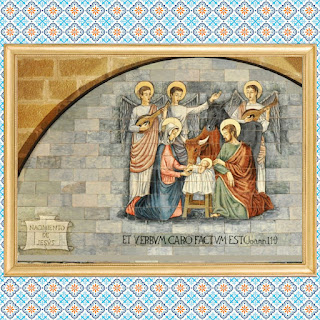
Torreciudad: The Nativity. God becomes man to live and die for us. Fruit of the 3rd Joyous Mystery: Getting closer to Jesus. Detachment from material things of the world.Video:

Ten tips to get the most out of your participation in the Mass.
1. Pray on the way to Mass. Whether you drive to a distant chapel or walk down the street to a cathedral, turn your attention to the coming celebration. Arrive five minutes before Mass.
2. Turn off your phone before entering the house of God.
3. Invoke the Holy Spirit to prepare you to participate in this amazing mystery.
4. Use your Missal, if you have one, the Mass app, or the missalette available in the church. By reading, or listening attentively, you can avoid distractions, following the prayers of the priest.
5. At the offertory, offer your loves, your worries, and your entire life, placing them beside the bread and wine being presented by the priest.
6. Pray with special care the Holy, Holy, Holy Lord…, united to the angels in adoring God. Live the Eucharistic Prayer feeling yourself to be part of the Church, the Mystical Body of Christ.
7. In consecration, do what you can to kneel before your Lord. Be united to the sacrifice of Jesus who is the only Victim. By doing so, you also offer to God the Father, through Christ, and with the Holy Spirit, all the sacrifices, sufferings, self‑denials, and troubles of each day.
8. Have the necessary preparation for Communion: you need –besides being in the state of grace– to have the right intention, and keep the Eucharistic fast.
(a) The eucharistic fast requires abstaining from eating and drinking, except water and medicine, for one hour before actual Communion time. The sick and the elderly, as well as those who take care of them, may receive Holy Communion even if they have taken something within the hour.
(b) Holy Communion may be received a second time on the same day when one attends Holy Mass again on that day, and when one receives the Blessed Sacrament as viaticum in danger of death.
9. Complete the Mass with an intense thanksgiving, devoting a few minutes to private prayer. In this way, your Mass will have a direct influence on your work, your family life, your dealings with others, and the manner you will spend the rest of your day. In short, the Mass should not be an isolated event of the day; rather, it should be the inspiration and the dynamo of all your actions.
10. Quietly leave the church to begin offering “your Mass” (that is, your family life, your work, and relaxation). You are now the priest of your Mass. Participate in each Mass as if it were your last. And remember to turn on your phone.
Torreciudad: The Visitation. Going to offer help. Fruit of the 2nd Joyous Mystery: Love of Neighbors.Video:

The Marian principle of the Church is centered around Jesus, the Son, who came into the world to manifest the Father and offer humanity the gift of salvation. However, for this gift to take effect, there must be at least one creature who represents humanity and accepts it with faith and availability.
Mary, through her "yes" to the incarnation and death of her Son, fulfills this role. In her acceptance, Mary becomes the beginning of the Church, serving as both its origin and her model. As a woman, Mary fulfills the prophecy of Genesis because only a woman can receive, bear, and give birth to a child. Thus, Mary is the New Eve, collaborating with and supporting the New Adam (Christ), and serving as the Mother of all human beings, particularly those who are born again through water and the Spirit.
Moreover, Mary, as the first believer, becomes the prototype of the believer. By observing her experience of faith, we can recognize the fundamental characteristics of a Christian believer.
During the Second Vatican Council, when the Church was deepening her understanding of her own mystery, the Marian principle was proposed as a counterbalance to the Petrine principle. The Petrine principle tended to identify the Church solely with her hierarchy, which is only a part of the Church. The Marian principle and the Petrine principle are interdependent, as one cannot exist without the other. However, the Marian principle holds a certain preeminence because without Mary's "yes," Peter would not have been able to pronounce his own
In the tumultuous post-conciliar years, when the feminist movement began advocating for women's access to the ministerial priesthood, this ecclesiological principle seemed to offer a fitting solution. On one hand, it recognizes the exceptional spiritual primacy of women due to Mary's divine motherhood. On the other hand, it protects the institutional male primacy through the analogy and symbolism of the sexes. If Christ is the Bridegroom, his institutional representative can only be male.
In his 1988 encyclical letter Mulieris Dignitatem, John Paul II clearly based his reflection on this symbolic ecclesiology. It allowed him to fully appreciate the feminine genius and promote the incorporation and participation of women at all levels of the Church and society. This was done without compromising the maternal prerogative unique to women and the male exclusivity regarding the ordained ministry.
Mary's experience of faith can be described by three key characteristics:
- Following Jesus, just as one follows a path to reach a destination.
- Discerning the message: she held everything in her heart and meditated on them.
- Accompanying: she was fully dedicated to accompanying Jesus so that he could fulfill what the angel had foretold (Lk 1:30-33), without coming between him and his Father.
Torreciudad: The Annunciation. Our Lady accepting her vocation. Fruit of the 1st Joyous Mystery: HumilityVideo:

The poor are regarded as the Lord's favorites. Love for God and love for riches are incompatible. Therefore, we must detach ourselves from earthly possessions. Additionally, we must strive to alleviate poverty in the world. However, it is important to note that the entire mission of the Church, which was received from her Founder Jesus Christ, should not be reduced solely to this urgent effort.
We must not downplay the reality of grave sexual sin. The Catholic Church's attention to all sins, including sexual sins, does not divert its attention from mainly social evils.
The esteemed Italian philosopher Augusto Del Noce predicted that this type of Catholicism would eventually succumb to society's "erotic offensive" by rejecting the Church's sacred doctrines on asceticism and mortification.
True to Del Noce's prediction, some have vehemently argued that "private" virtues such as chastity and purity have been excessively emphasized, particularly since the Counter-Reformation. They claim that this "sexophobic" morality is outdated and repressive.
To support their claims, they turn to the pillars of modern civilization, science and social sciences, which advocate for a more libertine sexual ethic. "Scientism" and "sociologism" - which lack a strong foundation - displace the supreme order of nature and morality.
Del Noce anticipated this division of virtues and its connection to the gradual erosion of ascetic Christianity. In its place arises a "secularized Christianity" that aligns more closely with our liberal, post-modern culture.
In this new form of Christianity, the social and political virtues (such as charity), intended to advance the human condition, overshadow the passive and private virtues like chastity and purity.
As a result, preachers rarely, if ever, discuss chastity and purity. Protecting marriage and the traditional family or addressing rampant promiscuity is perceived as far less urgent than helping the poor and persecuted.
However, peculiar things occur when the Church loses her coherence and focuses solely on public or social virtues. When the poor and persecuted adhere to traditional sexual morality (such as Africans), they are labeled as homophobic. Consequently, they are met with suspicion and condescension by some. Thus, the division of virtues becomes divisive in paradoxical ways and ultimately undermines the Church's mission of social justice.
This development is an absolute tragedy because ascetic Christianity, which upholds and promotes all virtues, is the true embodiment of Christianity.
Ascetic Christianity is deeply rooted in the Apostolic tradition, attested by numerous saints and martyrs, and affirmed by Jesus Himself, who condemned even the "lustful look" as a form of "adultery in the heart" (Matthew 5:27).
While these individuals may argue that they are more enlightened on these matters, their enlightenment casts far too many shadows.Video:

Being useful to Christ. The example of Jesus Christ inspires us to live our lives filled with constant little sacrifices.
When Andrew and Philip, excited by the glory their Teacher had gained, went to tell him that even the Gentiles wanted to see him, Jesus Christ immediately corrected their purely human optimism. He exclaimed, "The hour has come for the Son of Man to be glorified," referring to the establishment of his kingdom on earth. However, it would not be as they had imagined. As St. Augustine said, "Christ was not the King of Israel to collect taxes, raise armies, and visibly fight against his enemies. He was the King of Israel to guide souls, offer advice about eternal life, and lead those full of faith, hope, and love towards the Kingdom of Heaven."
Therefore, although the Lord could have chosen many other means, he chose to die on the Cross. "Truly, truly, I say to you, unless a grain of wheat falls into the earth and dies, it remains alone; but if it dies, it bears much fruit." St. Josemaría asks each one of us, "Don't you want to be a grain of wheat, to die through sacrifice, and yield a plentiful harvest?"
"Apostles are Christians who know that they are grafted onto Christ, identified with Christ, through Baptism; enabled to fight for Christ, through Confirmation; called to serve God with their activity in the world, through their participation in the royal, prophetic and priestly functions of Christ, which enable them to guide others towards God, teach them the truth of the Gospel, and contribute to their redemption through prayer and expiation."
"Christians who are ready to serve become guides, teachers, and priests for others. They are for those people, other Christs, or rather, as I usually tell you, Christ himself. However, let me emphasize that it's not about pursuing our personal ambitions. Instead, it's about being useful to Christ, so that he can act. It's also about being useful to others because Christ came not to be served, but to serve."
"Consider a nail, for example. If you encounter no resistance when hammering it into a wall, what can you expect to hang on it? Similarly, if we don't allow God to strengthen us through sacrifice, we will never become instruments of our Lord. On the other hand, if we choose to embrace difficulties willingly and use them for the love of God, then in the face of what is difficult and unpleasant, when things are tough and uncomfortable, we will be able to exclaim with the Apostles James and John: Possumus! Yes, we can!"
Let us ask our Mother, the universal Co-redemptrix, in union with Jesus Christ, to help us let go of all resistance to personal sacrifice so that our apostolate may bear abundant fruit.Video:

Apr 28 Sun
To meditate on the words of Jesus about the vine and the branches is to meditate on his legacy in a more profound way. It’s still more profound than in the previous Sunday with the Shepherd and the sheep.
The branch is an extension, a prolongation, of the same plant, the vine; it was born from the vine. From it, the branch acquires the fluid that feeds it, the humidity of the ground, and everything else that makes it possible to be transformed and eventually, to produce grapes. By itself it can produce nothing, nothing serious, not a branch of grapes, nothing.
It is the same truth that St Paul teaches us with the simile of the body and its members. Christ is the head of the body, which is the Church. Any Christian is a member of her. Any member separated from the rest of the body can do nothing.
How does how does it apply to us? By instinct, it goes against our sense of autonomy and freedom. We always feel being a complete unit and not a part.
Likewise in baptism, we, who were wild olives bearing no useful fruit, became grafted into Christ. We became branches of the true vine, branches of a good olive tree. All this because of the force of the Holy Spirit (grace) which has been given to us. Communicating both, the vine and the branch, there is the Holy Spirit.
What is then our duty as branches? Saint John has a favorite word to express it: “to remain,” understood as united to the true vine, which is Christ. Remain in me and I in you…, if you do not remain in me…, whoever remains in me... To remain attached to the vine, and remain in Christ Jesus, means, above all, not to abandon the commitments assumed in baptism, not to escape to a distant country like the prodigal son.
I am doing well, you may say. But can I assume to be attached to Christ on one instance, and soon after live a bad life, as if I were a visitor of Christianity? Like some, may I continue not living my Christian vocation seriously, going day after day from infidelity to infidelity, permissiveness after permissiveness, leaving out commitment after commitment, leaving behind first, going to communion, then even going to Mass, then praying, and finally abandoning everything? …and still think that everything is ok?
To remain in Christ Jesus also signifies something positive: to remain in his love. That is, in the love he has for us, rather than the love that we have for him. It means to allow him to love us, to pass on to us the feeding fluid, which is his Spirit. Avoiding placing, between him and us, the insurmountable barrier of self-sufficiency, of indifference, and of sin.
Then Jesus shows us the consequences of separating from him: the branch becomes dry; even is externally looks good, it becomes a useless branch incapable of giving fruit.Video:

Do not settle for defeat. We must humbly ask for God's help, and make a sincere effort to use all the means available.
“Don't be anxious about your past mistakes, or the possibility of future faults. Let's abandon ourselves into God's merciful hands. Let's show him the desires of holiness and apostolate which are alive beneath the ashes of our apparent coldness. He is listening to us. You only have to talk."
Jesus went up to Jerusalem. There was a paralytic by the pool.
The Lord, who is the doctor of souls and of bodies and who has come to heal all those who believed in him, fixed his gaze on one alone among all the sick people there, in order to cure him. It was a sign of special love, like the love Jesus showed us by calling us to Christian life from among so many people.
When Jesus saw the sick man, and knew that he had been lying there a long time, he said to him, "Do you want to be healed?" Likewise, the Lord saw us helpless in our weakness, and reading the desires latent in our heart, he uttered that sweet demands which, with his grace, we accepted.
St John Chrysostom comments: The paralytic man was not annoyed by the question, nor did he say: "Have you come to insult me, asking me if I want to be cured?" On the contrary, he replied meekly: "Sir, I have no one to put me into the pool when the water is troubled, and while I am going, another steps down before me." He did not know who was questioning him; much less that he would cure him. He may have thought that Christ would help him into the water. Instead, Christ showed that his word alone could do everything. Our Lord is always ready to listen to us, but he wants our personal response, shown in the effort we make to get out of any situation which prevents us from following him closely.
St. Josemaría taught us that in the interior life “there is but one fatal illness, one deadly mistake you can make: to settle for defeat, not to know how to fight with the spirit of a child of God. If this personal effort is lacking, the soul is paralyzed and languishes alone, and is incapable of bearing fruit."
“Such cowardice on man's part puts pressure on our Lord to utter those words addressed to him by the paralytic at the pool of Bethsaida, –I have no man to help me!"
“What a pity if Jesus does not find in you the man or the woman he expects."
Once more, God shows us that his goodness is beyond human calculation. Let us tell him now, simply and plainly: "Yes, Lord, I want to be healed, I want to be freed from this impediment that separates me from you, and prevents me from living to the full the divine life to which you have called me."Video:


